As out of place on a hard-rocking Tin Machine album as something like 'After All', this is the single moment when Tin Machine actually created something worth listening to. That it sounds far more like a Bowie solo track than a Tin Machine band effort is, obviously, neither here nor there.
From Bowie's great lost album, a title track which both stands alone as a great song and harks back to previous moments of glory, even to the extent of quoting from 'All the Madmen'.
Best heard on the Deluxe cd reissue of the first album, 'David Bowie' (where you get three different versions for your money), and brilliantly covered by the Last Shadow Puppets, this is a great tune with fabulous lyrics, and deserves to be far better remembered than it is.
There's an updated version of this seventies out-take, recorded as part of the Toys project and eventually added to the 'Diamond Dogs' re-issue, but this more acoustic version, available as one of the extra tracks on the Rykodisc release of 'Man of Words, Man of Music' is the superior release.
Most times Bowie collaborates it's obvious that Bowie is the driving force - think 'Little Drummer Boy' with Bing Crosby or 'Under Pressure' with Queen - but here he's just a vocalist doing a duet on someone else's album and he turns in a sparkling performance, aided no doubt by the steady hand of Tony Visconti on production duties.
I always loved this song, both in the Bowie original and the Beatstalkers excellent cover, but I can never seem to convince anyone of the fact that the lyric is the darkest Bowie ever wrote: the story of a four year old boy dying of some horrible unspecified illness while his parents marriage collapses around him in a welter of recrimination and blame. And then the last verse which would break the heart of a stone man. God, it makes me miserable just thinking about it...
Well, there has to be something from Bowie's frankly mildly bonkers decision to release an EP of Bertolt Brecht songs - and this is my favourite one. A real tour de force of singing and some great lyrics.
Sadly not available on Spotify so the link goes to You Tube, but it is on a best of cd which every self-respecting Bowie fan should own. A cover version of a Bowie song which DB never recorded himself, this is The Great Lost Bowie song, especially if you like his early, post-fame stuff.
The Magic Mole in the Adventure of the Velvet Curtains
Has there ever been a less likely Torch singer than Cilla Black? She spent her teens and early twenties looking as though she'd borrowed her big sister's clothes, and her later years as the ginger love child of Mrs Thatcher and Larry Grayson. She's got a Liverpool accent so thick that even when singing it keeps popping through like an unwelcome neighbour scrounging sugar. And she has that weird mole, sometimes blacked in like a beauty spot, sometimes covered over with enough make-up to fill the space under every nail on your hand. And latterly, gone altogether.
You can certainly have plain torch singers (Nina Simone was no classic beauty for a start) but Cilla surely takes the prize for plain odd.
In any case, she was a marvellous singer when she got going, with a set of lungs like a bouncy castle and a huge voice with so much power that it could turn geraniums into coal. And that's what counts really - the fact that any self-respecting record collection should have a cd of her singles.
The one I have on just now is this one, and as well as nearly twenty brilliant singles (and sundry crap later tracks) it also contains a decent dvd summary of her career, showcasing performances ofrm the 60s and 70s on various TV shows, including her own eponymous one.
She starts off doing You are my World at the Royal Command performance, wearing her mother's old velvet curtains turned into a dress, sensible shoes and a haircut presumably designed to woo her lesbian following. Barely moving from her spot in the centre stage, Cilla's fine but nothing special.
Skip forward a few months and here she is on Ken Dodd, fashionable haircut and 60s mod dress in place. It's a far better look, even with the puppy fat and mole on her chin, so it's just a shame that she seems to have been taking lessons in hamming it up from Donald Sinden as she does a very nice live version of Don't Answer Me partially ruined by a series of huge sweeping motions which wouldn't have looked out of place in an early Kate Bush video.
Next up is the brilliant Step Inside Love. I'll forgive Cilla for talking at the beginning of the clip - it's not her fault she's Liverpudlian after all -because her singing is so good. Her skirt's micro-short this time round, the mole is coloured in and Christ does she look uncomfortable, battering the song into submission in that gigantic voice of hers and waving her skinny arms around in vague approximation of the beat like some prototype Ian Curtis doing a cabaret turn at Butlins...
1968, and she's obviously decided that wearing skirts so short you can all but see her knickers is not for her - so she's decided to dress like Princess Anne's idea of a Mod instead. Oh well, it's her show, she can wear what she like. And she absolutely nails Love's A Broken Heart.
TOP OF THE POPS! One of her lesser songs, true, but even doing Where is Tomorrow? Cilla on TOTP is something to savour. Disappointingly the majority of the performance has been directed by a git, determined to show only Cilla's head and shouders, so it's impossible to tell if it's just the collar of her dress which is curled up on itself or if she's buttoned it up wrong and thus looks a little bit special in full view.
Liverpool Lullaby is obviously a song Cilla is comfortable singing, but even so she couldn't look more odd than in this clip from 'Cilla'. She's wearing another very short dress and cool shoes, for a start, which is a better look on Twiggy than Cilla, but with the sort of haircut more suited to her mum and which at times threatens to make her look middle aged. For the first time on this dvd in fact she looks like an entertainer than a singer, someone who parents might like at least as much as teenagers do. Take away the dress in fact and chuck her in a trouser suit and she could present Surprise Surprise no bother. The only surprise in this really is that there's no dancers pretending to be starving in the snow or anything behind her as she sings.
Arrgh - duet with Cliff! He's a good looking lad that Cliff - until he sings, when his mouth goes all weird and you can hear his bloody cringingly sincere voice. Horrible.
20th February 1969 - I was an embryo by this point! I suspect even then I could dance better than Cilla, who bops around at the start of Surround Yourself in Sorrow on TOTP, but presumably in time to a different song that only she could hear or even to the voices of dead christian missionaries singing Hallelujah in her head. Or maybe she was having a very minor stroke? And she's miming! Bah. Humbug.
I can't stand Yesterday and would have skipped past it had it not been the first colour clip. Even then I only managed 27 seconds: just enough time to check out Cilla in a red dress which just about covered her arse and with her hair now long and ginger, as opposed to short and an indeterminate colour in black and white. She looks almost exactly like Liz from Corrie actually.
From what is presumably the same 71 tour, she then does Going out of my head fairly dully, except for the fact she's back to wearing curtains as clothes again, this time yellow and billowing, making her look like Margot from the Good Life or a slimmed down post-op Demis Roussos. Not great on any level.
You've Lost the Loving Feeling - hate that song and Cilla's rubbish at it, starting off too low to allow her to hit the later high notes. I am Woman? You're So Vain? I can Sing a Rainbow? Imagine!?!?! Oh bugger off - all that's left is a succession of bad cover verisons briefly envlived by Alfie from 1973 sung by Cilla looking every inch the comfy seventies variety artiste so I turned the dvd off there and watched Black Books instead.
All in all The Ultimate Cilla is worth picking up for the superb disc of singles. The extra disc of music is patchy, leaning towards rubbish at times, but with enough interesting stuff to pass a happy hour.
And the bonus video is awesome! From 2003, it features Cilla miming in a tasselled cowboy jacket and boot cut jeans, spinning like a compass on the heel of one boot, with a slightly humiliated bunch of what seem to be christian rockers playing behind her. You just don't get enough of that sort of thing...
Cilla and the Christian Rockers
Cilla when she was good, doing Norwegian Wood with the Shadows
And that was Bagpipe Whisky with their Asparagus Puppy EP
Like most people my age I suspect, I seem lately to have got in real rut musically. I own thousands of albums and cds and mp3s but I tend to find myself putting on the same dozen or so albums over and over again. Bit of Antony and the Johnsons, bit of Bowie, maybe a track or two by Frightened Rabbit, the Eels or a compilation of my favourite tracks. Rarely anything new.
And it used to be so different.
Back in 1984, lying in bed in the dark, listening to John Peel discussing the latest Liverpool game in between tracks, writing down band names on pieces of paper (is Bogshed one word or two? where the hell can I buy Retard Picnic by the Stupids? Are I, Ludicrous more like the Fall or Half Man Half Biscuit?) or borrowing albums from our mate Dave, who had effortlessly cooler music taste than anyone else I knew ('you'll like this', shoving a copy of 'Y' by The Pop Group in my hand before we headed to the pub. He was right).
But now it's 2009, and I don't seem to have the time any more. Plus DJs are all about wacky catchphrases, irritating jingles and comedy sidekicks. So I hear far less new music than I used to.
Until last night, when I downloaded a podcast by an iPal, Ned, who likes Iris and wrote a nice story which almost made it into the Panda Book of Horror. Plus he seemed to have good music taste, which is handy.
(I've always been a bit wary of podcasts, incidentally. Just an excuse for spods to talk at interminable length about how much they fancy David Tennant, or for fans of Radio 4 to pretend that theirs is the only kind of radio that matters. As dull and pointless as Craig Burley, frankly.)
To cut to the chase - since I'm supposed to be taking Matt and Cameron round to Spar to buy gogos - Ned's podcast was brilliant. It lasts an hour and 8 minutes and I'd stuck it on the mp3 player for when I was walking the dog, thinking I'd give it ten minutes then switch to the new Twilight Sad album.
By the time Ned signed off, the dog was knackered and I was soaking after an 80 minute walkin the rain, but it was well worth it. Someone doing radio in a normal speaking voice, interspersing the music with brief chat about what was going on round them ('it's pissing down' Ned pointed out at one point - at least he was indoors!) but crucially remembering that the show was primarily about the music, not the chat.
Of course it helped that the music was worth listening to. Not all my cup of tea but some great stuff (for those interested, I was particularly taken with the first track, a cover of Blue Midnight by a band called Grand Erector and by an extended drone by a Norwegian guy) and always interesting. Plus a good little interview with James from the mighty Twilight Sad (whose new album is worth a listen btw).
It's obviously a work in progress - the segues during the interview into Twlight Sad tracks were a little too abrupt, and I've never been a fan of little clips of songs as played during the recommended Five Tracks section, but other than that it was all spot on.
I mean how can you not love any DJ who says, in a conversational tone, 'That was Bagpipe Whisky with "Men Bason" from the "Asparagus Puppy" EP"*?
Iris Wildthyme's acerbic bosom companion, the redoubtable Panda, has been kind enough, in between doing interviews for his new book, to allow me to record for posterity an evening's musical entertainment chez him.
Which means that so long as you have Spotify, just click here for an hour or two's musical highlights from a gentler, more innocent time...
Being a fan of all periods of David Bowie should be a real problem, you'd be forgiven for thinking.
After all, the man is better known than any other artist in music for constant re-invention. The word 'chameleon' is defined in the OED as, in part, 'pertaining to David Bowie'.*
This problem is particularly apparent when listening to Bowie's first studio album, the eponymous 'David Bowie'.**
It really is a struggle to come up with another artist who made such a massive sea-change in direction - in Bowie's case from whimsical, English music hall to sex-obsessed Glam Rock - in so short a period of time.
Consequently, Bowie's brief early years do contain whole albums which seem hard to place in a logical, consistent and organic timeline.
David Buckley described this record as "the vinyl equivalent of the madwoman in the attic" and while that probably suggests a greater degree of sound and fury than is merited, Gus Dudgeon's claim that it was the 'weirdest thing Deram had ever put out" seems closer to the mark.
It certainly stands out even in the Summer of Love, eschewing the sort of hippy love and peace concerns suggested by the faintly psychedelic cover font in favour of a succession of mini-stories, flavoured by vaudeville and music hall rather than drugs and free love (the drug and, well, gang obsessed 'Join the Gang' is the odd track out in this respect).
Because of this, any search for musical fellow travellers (other than the perennial laziness of pointing solely to Anthony Newley) for David Bowie leads only to individual songs rather than actual sustained work: bits and pieces of the Beatles output (most obviously John Lennon's 'Being for the Benefit of Mr Kite'), occasional Kinks' tracks and obscure British psych acts like The Blossom Toes.
The Beatles more whimsical moments are, in fact, the closest popular match for these early Bowie tracks. Utilising brass and strings, recording tracks with odd timings ('Maid of Bond Street' is in waltz time, for example), and injecting humour via the spoken word and 'funny' voices ('Please Mr Gravedigger' in particular) are all elements which have a mirror in Yellow Submarine/Pepper-era Beatles.
That the Beatles-influenced tracks generally work far better is a sign that Bowie was as yet an emerging artist, still finding his musical feet and searching for a voice of his own, but there are things to admire in this first, uneven recording.
Most obviously, it is possible to trace certain of the themes which Bowie embraced right up until the early 80s in this very early and atypical work
'She's Got Medals' deals with cross-dressing and trans-gender issues, 'Uncle Arthur', 'Maid of Bond Street' and 'Little Bombardier' address unusual, possibly illicitly sexual, relationships and 'We Are Hungry Men' concerns itself with a dictator/Big Brother/messiah figure attempting to save a future dystopian society.
Of the two other primary thematic threads on the album, however, one is quickly discarded by Bowie after this album and never shows up explicitly in the future, whilst the other remains a staple only briefly and very rarely appears in later recordings.
The soon to be discarded theme of the effect of recent wars is evident in 'We are the Hungry Men' ('Achtung, achtung, these are your orders') and 'Little Bombardier' ('War made him a soldier...Peace left him a loser'), and even a throw-away like 'Rubber Band' (with its petulant and painful spoken 'I hope you break your baton' final line) slips a reference to the First World War into its music hall pastiche. War remains a potential lyrical source for future Bowie, but never quite so specifically.
The themes of innocence and the positive elements of childishness, however, are very pronounced on David Bowie and are also the areas in which Bowie moves furthest away from the straight music hall and in the direction of the Syd Barrett/Gong style nursery rhymes which made up another strand of very British psychedelia.
'When I Live my Dream', 'There is a Happy Land' and 'Silly Boy Blue' set the template for a fair portion of Bowie's songs before he embraces 'rock' with The Man Who Sold the World. Swooping strings and overblown and fantastic lyrics (reincarnation, slaying dragons and a 'special place in the rhubarb fields' all on one album!) combine with fears that the real world is threatening our innocence, and push this specific strand of Bowie into the realms of the quainter fringes of the hippy counter-culture.
Fortunately, Bowie redeems himself by his ability to engender real emotional impact from what seem at surface level to be trite place-holder tracks. Later on, the theme of childhood threatened would lead to the subtly despairing 'When I'm Five', while straight-forward romanticism would reach it's peak in the beautiful 'In the Heat of the Morning' (though it's possible to see echoes of this approach as late as the 'Absolute Beginners' single in 1986).
In the end, there are enough areas of overlap between this album and later Bowie works to appeal to the die-hard fan. Putting those people to one side, however, and this is one Bowie record which is, at best, a curio and an example of an era rather than of an artist coming into his own.
That Bowie had discarded all music hall elements by the time he recorded his next album, Space Oddity shows that he too recognised that this approach was not one on which to build a career.
Side one
"Uncle Arthur" – 2:07
"Sell Me a Coat" – 2:58
"Rubber Band" – 2:17
"Love You Till Tuesday" – 3:09
"There Is a Happy Land" – 3:11
"We Are Hungry Men" – 2:58
"When I Live My Dream" – 3:22
Side two
"Little Bombardier" – 3:24
"Silly Boy Blue" – 4:36
"Come and Buy My Toys" – 2:07
"Join the Gang" – 2:17
"She's Got Medals" – 2:23
"Maid of Bond Street" – 1:43
"Please Mr. Gravedigger" – 2:35
* Not really, but it bloody should be
** For convenience, I'll be ignoring those early RnB singles with the Lower Third, Manish Boys etc that are forever being repackaged and re-released on cd.
'Like Billy Bragg in 'My Youngest Son Came Home Today' mode', according to Jim. It's a compliment.
Whereas according to me (in a 30 second mailing list comment I'm lazily recycling)
"If The Telescopes had had more than just 'The Perfect Needle'; if My Bloody Valentine had mastered decent lyrics; if Spacemen 3 had had a bit more discipline, they might have been The TwilightSad, only not as good.
Singing in a broad Scottish accent over washes of big guitar, The Twilight Sad can hopefully manage to wrest the indie guitar crown away from generic pop rock bands like The Killers and shitty tadium fillers like Coldplay and U2."
Lauded as the next big thing by the music press, Glasvegas ultimately fail to fulfil the promise of their demos from last year, turning out an album of bog-standard guitar tunes, like a poor man's Twilight Sad or - given that I swear they play bagpipe on their guitars at one point - a Big Country tribute band.
They're not rubbish, but neither are they as awesome as NME would have you believe. Highlights are 'Geraldine' (primarily for the lyric 'My name is Geraldine and I'm your social worker') and the (almost) novelty track 'Stabbed', which is a poem recited over Beethoven's Moonlight Sonata and so gets points for at least trying something different.
Disappointingly one and a bit-note and dull, really.
This is far more like it. If The Twilight Sad are Arcade Fire with better melodies and lyrics and proper accents, and Glasvegas are Big Country with attitude (trite labels, don't you just love them?), then Frightened Rabbit are the distillation of every Scottish pop band ever (lyrically particularly Aztec Camera) crossed with the indie mega-brilliance of The Wedding Present. Flat, accented vocals, jangling guitar lines and miltary style drumming, combine with razor sharp lyrics to make this the best album of the three.
I'll stick to my guns, but from now on it's war I am armed with the past, and the will, and a brick I might not want you back, but I want to kill him
and
and leave the rest at arm's length keep your naked flesh under your favourite dress
You can hear them here but really, buy the album as well - only then will you realise why I haven't listed my favourite songs off it. It's because they're all brilliant.
In lieu of a review of this week's Doctor Who (I'm going to do it as a complete two-parter next week), some mini-music reviews, mainly consisting of comparisons to other bands and disparaging remarks about how the originals were much better.
A first solo(ish) project from Alex of the Arctic Monkeys, in collaboration with a guy from some band called The Rascals, this album is designed from the outset to distance itself from the Monkeys. What this means is that the killer riffs and clever lyrics of the first Monkeys' album is replaced by an almost lounge sound, full of acoustic guitar, piano and languid vocals. At first I was inclined to file it alongside Richard Hawley, then I shoved it up a grade or two to the realms of the mighty Scott Walker which, after a few more listens, is obviously insane.
Then, quite separately, both Mags and Scott pointed out the obvious - it's Marc Almond in his strings period, all lush backing and sub torch song vocals. Nothing wrong with that, of course, but it's an unexpected direction for the boy Alex to take and one where he's in danger of failing to live up to similar sounds from those who've come before.
A popular female country singer doing an album of Dusty Springfield covers. If ever an album had 'sure fire success' success stamped all over it, surely this was it? And in the hands of a Lucinda Williams it would have been - full of big, powerful vocals sung over countrified backing, with the pop sound of the Dusty originals replaced by steel guitars and a bit of funky banjo. Instead of that, however, we get Shelby Lynne turning some of the most energetic and vital melodies of the last fifty years into hushed, sepulchral ballads. All the passion and power has been removed along with every scrap of fun from Dusty's versions, and all that's left is spare, bare songs devoid of all purpose and impact and destined to be forever relegated to background music.
You prefer the tracks which are actually songs as opposed to Sonic Boom recording the sound of water dripping in a metal basin and then taping down the B3 key on his Hammond organ, before looping the dripping water interminably?
You even have the first couple of Spiritualized albums and listen to them a lot?
Good, because that's fine, fine music.
Stick with that and forget Spiritualized still exist, though: unless you're a bigger fan of 13 periodBlur than you ever were of Spacemen 3, you won't be interested in this album. Because that's exactly what it sounds like, even down to the whiny, effects distorted vocals. It's a decent enough record, but not what I expected from Spiritualized - give the single a listen before you buy, I'd recommend.
Unassuming and pleasant pop sound which completely fails to grasp the attention in any meaningful way. This is exactly the kind of cd which will disappear as soon as you put it alongside the rest of your cds, and which you will never be listen to or think about ever again.
Saving the best until last. Hard to describe but 'Tom Waits meets Ethel Merman' is the best attempt I've heard. 'Hymns, dirges and Shirley Temple songs', as Baby Dee puts it. Go out and buy this album now - the title track in particular is a contender for song of the year.
You don't need to be a long-term Fall fan to know that any concert headed by Mark E Smith is as likely to explode in recrimination and argument as run smooth as clockwork.
Buy Totales Turns or Seminal Live (actually, scrub that - buy Totales Turns because Seminal Live is shockingly bad even by the standards of the Fall's often contractually obligated back catalogue). Put on a random track. It's an evens chance you'll hear MES shouting 'stop, stop - this is shit" rather than the expected sound of a professional band effortlessly going through their live paces.
So it's not like we shouldn't have been prepared for Von Sudenfed, earlier on this week at the Liquid Rooms here in Edinburgh.
Granted, the support band was truly awful (I'll spare their blushes and not name them, mainly because I have no idea what they were called), but that's par for virtually every gig I've ever been to. Doesn't mean the main act is going to be equally inept.
At around about nine, two of the Von Sudenfed collective wandered on stage, took their places behind a massive set of decks and speakers and began pumping out a bass line that made my heart shudder like jelly in a balloon. I think the track they were playing was 'Fledermaus Can't Get Enough' but if I'm being honest any sound these two made was just a backing track for Mark E's ranting lyrics in my mind. And there was no sign of him even five minutes into the first track - just the two DJ types (who looked suspiciously like Owen Wilson and Ben Stiller in Starsky and Hutch) dancing groovily behind their big machines.
At that point Smith walked on and it was easy to believe that this was showmanship, as he barked out something largely incomprehensible and headed to the far side of the stage, where he turned his back on the crowd in traditional Fall fashion.
Except he clearly didn't know the words (not a major problem since he was reading them off a handful of sheets of A4) and was pretty obviously half-jaked (not necessarily a problem - he's no Sinatra at the best of times and a bit of whisky-related lubrication might be no bad thing).
What was a problem though was that after singing half the song reasonably competently he appeared to start reading the lyrics to another song by mistake, then sauntered back across the stage and disappeared into the wings.
'Off for a fag," I said, but if so it was a long one since he didn't re-appear for about ten minutes, and even then only lasted another five before wandering off again. His voice was heard from offstage during 'Flooded' (much more strongly than had been the case when we could see him, leading to a slight suspicion that the DJs were playing a pre-recorded tape loop of the vocals) and he did come back on stage for the encore, but otherwise it was pretty poor, really.
The DJs battled on throughout, playing a handful of the songs from the album, but I didn't hear either of my personal favourites, 'German Fear of Osterriech', and 'The Rhinohead'.
The last two gigs I saw at the Liquid Rooms were Arthur Lee and Television - two acts well past their prime, but both capable, as they demonstrated, of a genuinely high quality live act. Mark E Smith on the other hand - a man who once routinely stopped the Fall mid-track if he thought the live playing wasn't up to scratch - was a shambling liability, contemptuous of the audience in a way you wouldn't have seen ten years ago.
There's a great track on the album called 'Family Feud' in which Smith repeatedly sings the tongue-in-cheek refrain "I am the great M E S". For all his faults as a performer, he's no less a lyricist than he ever was, and he will have been aware of irony of the other way to read the line - on this form Smith as a performer really is a mess.
It's the perfect name for this album., on so many levels.
First off, it's about taking the grit of old, almost forgotten music and burnishing it, turning it into something new and beautiful, like an oyster turning some speck of dirt into a pearl. Then it's the grit which Martyn Bennett must have needed to produce the finished product, seriously ill as he was and apparently unable to play the pipes, only capable of taking other people's work and mixing it with his own visions. Finally, the source material - the collection of Lomaxian field recordings which lie at the heart of the album - are as gritty as it's possible to imagine in these modern shiny days.
It's probably not to everyone's taste, not even those who bought Bennett's previous albums. I have those too, bought on the back of hearing Grit and, Glen Lyon apart, they're not quite the same kind of thing at all. There's some good stuff on there (particularly 'Tongues of Kali' from Bothy Culture, which is a mad whirl of an instrumental track), but they're more musicians' albums than listeners, made to dance to in clubs where techno tracks with no apparent names on white labels are the thing.
There are a couple of similar tracks on Grit, but primarily it inhabits a whole new astonishing world. The most obvious touchstone for anyone considering buying the album is Moby. Swap American spirituals sung by big throaty black women for recitations of the Old Testament by Scots patriarchs and you're in the right area. Which makes it sound a bit serious and religious - and at times it is - but that's not the entire story.
Where something like 'Liberation' (the aforementioned Old Testament track) is stark and black, anchored by the booming voice of some Island Minister intoning the 118th Psalm over a techno beat, and the track 'Chanter' with its repeated refrain 'You play the melody on the chanter' sounds like something from Bothy Culture, the album also contains almost fragile pieces like 'Wedding' and 'Why'.
It's all good, but it's a trio of tracks which raise Grit from the realms of the merely great to that of the utterly magnificent.
In order of appearance, 'Nae Regrets' hits the speakers first. It's an amalgam of two seperate tracks - Edith Piaf's No Regrets' and a Scots-Romany traditional song sung by Annie Watkins. The two songs run into and bounce off one another like punks pogo-ing in the mosh pit to create a final product which, to quote one review, "kicks ass like ass is going out of style".
Next comes 'Ale House' sung by someone famous on the Scottish folk scene, the traveller Jeannie Robertson. The song used as the basis for the track is presumably the 'Ale House' of the title, but whatever its provenance, the voice is powerful and filled with humour, detailing the adventures of a 'bonnie wee lassie who never said no'. In some ways it's a similar trick to that employed in 'Nae Regrets' as the Romany voice unexpectedly finds itself underpinned by the heavy drums of a dance beat, but it's just so incredibly well done and so filled with genuine joy that it doesn't matter in the least.
Finally, 'Storyteller', the track which closes the album, is amongst the oddest mainstream tracks ever to make its way to release. Over ten minutes long and using as its base a poem from 1955 recorded by a tinker, the fact that the poem is called 'The Maiden Without Hands.' tells you most of what you want to know about the wierdness but fails miserably to explain the power of the remastered whole. It's stunning, that's the only word for it.
Martyn Bennett died of Hodgkin’s Lymphoma in 2005 after recording only five albums, Grit being the final album released before his death.
It is the finest album ever to come out of Scotland - in the words of the speaker on 'Liberation', it is "the Lord's doing, and it is marvelous in our eyes."
I had a hangover when I first heard Jandek. That might explain why I like his music.
Discordant, tuneless and out of key, Jandek's first album, Ready for the House is the musical equivalent of the day after the night before.
It's not music that it's easy to admit liking in any case - both because it's hard to pin down what there is to like amongst the sibilant singing and untuned, one note guitar picking, and because expressing a fondness for something so unmusical leaves you wide open to claims of supreme and unmitigated pretentiousness. Kurt Cobain, no stranger to arsey waffling himself, once said of Jandek that the singer isn't pretentious, but his fans are.
Which is hard to argue with once you've watched last year's documentary, Jandek on Corwood, in which one fan points out quite ferociously that he files the first Jandek album (initially released under the name 'The Units') under 'U' and not 'J', whilst another repeatedly stresses that 'Yandek' is a better pronunciation of the singer's name (similarly, on the one and only Jandek mailing list, a poster recently proudly described his 'ordeal' in listening to every Jandek album in one sitting, including headaches, sweating and vomiting. Rather than suggesting listening to music he genuinely liked, the consensus seemed to be that his was a bold experiment and that he had basically taken one for the team).
Far easier then to say that you like the idea of Jandek the mystery man, even though the documentary's attempts to divine the purpose of that mystery has also been slammed by some fans, concerned that such behaviour somehow cheapens the whole Jandek experience. Out simply, until last year no-one had ever met the man behind Jandek, save for a possible meeting with one journalist and a single phone call with John Trubee. Iwrin Chusid, author of Songs in the Key of Z, the bible of what's generally lumped together as Outsider Music then devoted a fair chunk to his book to Jandek, further raising his profile from 'completely anonymous' to 'virtually no-one has heard of this guy'.
Contributing to the mystery was Jandek's reputed willingness to send dozens of copies of his albums free to anyone who reviewed them; the fact that for a long time the only way to buy his cds was via mail order to a Houston, Texas PO Box registered to Corwood Industries; and the fact that he didn't even have a definitive real name, never mind play live (Sterling Smith is the name most usually associated with Jandek, but even that is based on a credit in a single review from 1978).
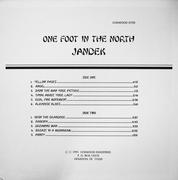
His album covers are equally perverse in today's heavily marketed musical world - all feature bland images of houses; amateur snapshots of a man at various points in his life; or blurred and indistinct pictures of curtains and drum kits taken inside a house somewhere. The back covers are plain white with a couple of black lines, the name of the artists and a track-listing with timings.
Such is the level of involvement by the fans in the mystery that when he released 'One Foot in the North' with a different font on the back cover there was much discussion as to what light the vaguely 'Chinese restaurant menu' font shed on the man and his work (none at all, so far as I can see).
Maybe it was all an incredibly clever marketing ploy - drag the fans in with the mystery and the deliberately non-musical nature of the sounds then sell bucket loads as the Jandek Craze sweeps the nation? Not likely - until very recently you could probably count the number of genuine sales of any single Jandek album in the hundreds rather than the millions and retailing at £4 each they're hardly the world's most expensive items in any case.
Or possibly the 'artist' is mentally ill and releases these albums of sound and fury as part of his therapy? Or it's some kind of tax dodge. Or it's all a long and complicated practical joke. Or one of the many other theories that have been put forward about Jandek since 1978.
I have no idea personally, and matters were further complicated when 'a Representative from Corwood Industries' turned up unannounced at a Glasgow music festival in 2004 and proceeded to play some very Jandeky songs. When that show was then released by Corwood as Jandek's first live album (Glasgow Sunday) it was confirmed that the Representative and Jandek were one and the same.
Not that any of that helps with the larger questions - we now know what Jandek looks like (and it seems pretty certain that the man on certain Jandek album covers is the Representative himself) but are no closer to figuring out why he does what he does, nor what it is about some combinations of atonal guitar playing and off key singing that proves to be so profoundly moving when brought together.
Because when all's said and done, the sole reason to listen to Jandek is that he can at times produce such utterly humane music, where the hurt in the singer is so plain that you can almost touch it. There's something very voyeuristic about a lot of Jandek's music and it's that I think which attracts fans as much as the mystery which surrounds him.
"I passed by the building you were working in I wanted to step inside it I wanted to lie in your arms again I passed by the building that you live in And I wanted to die I just stood there and cried For then the way I felt For the way I was gonna cry For loving you I passed by the building where you sleep And I wanted to sigh At the sweet smell of your loving But I just weep at the morning I just weep"